
The legal minimum tyre tread depth for cars, light vans and light trailers in the UK is 1.6mm. That minimum must be present across the central three-quarters of the tyre's tread width and around the entire circumference of the tyre.
That sounds simple, but there is an important detail: checking only one point on one tyre is not enough. Tyres can wear unevenly, so the safest approach is to measure several points across the main grooves of all four tyres.
In this guide, we explain the UK tyre tread depth law, how to measure tread properly, what the 20p test can and cannot tell you, and what to do if a tyre is close to the legal limit.
What is the legal tyre tread depth in the UK?
For most cars and light vans used on UK roads, the legal minimum is:
- 1.6mm tread depth;
- across the central three-quarters of the breadth of the tread; and
- around the entire outer circumference of the tyre.
This is set out in the Road Vehicles (Construction and Use) Regulations and is also stated in the Highway Code and MOT inspection guidance.
The important point is that a tyre is not legal simply because one groove measures 1.6mm. The required tread must be present throughout the relevant section of the tyre and around its full circumference.
Does 1.6mm apply to the whole tyre width?
The legal requirement for cars and light vans applies to the central three-quarters of the tread width.
That does not mean the outer edges should be ignored during your own checks. Uneven wear on the shoulder of a tyre can still indicate alignment, pressure or suspension problems, and cuts, bulges or exposed cords can make a tyre unsafe even when the central tread depth is above 1.6mm.
So treat tread depth as one part of a full tyre inspection rather than the only thing that matters.
How do you measure tyre tread depth accurately?
The most straightforward method is to use a tread depth gauge.
A gauge gives you an actual measurement in millimetres, which is much more useful than relying on appearance alone.
Step 1: Park safely
Park the vehicle on a level surface, apply the handbrake and switch off the engine.
Step 2: Turn the steering if needed
For the front tyres, turning the steering wheel can make the tread easier to access and inspect.
Step 3: Find the main tread grooves
Measure in the principal grooves of the tread rather than on a raised block or shoulder.
Step 4: Insert the gauge
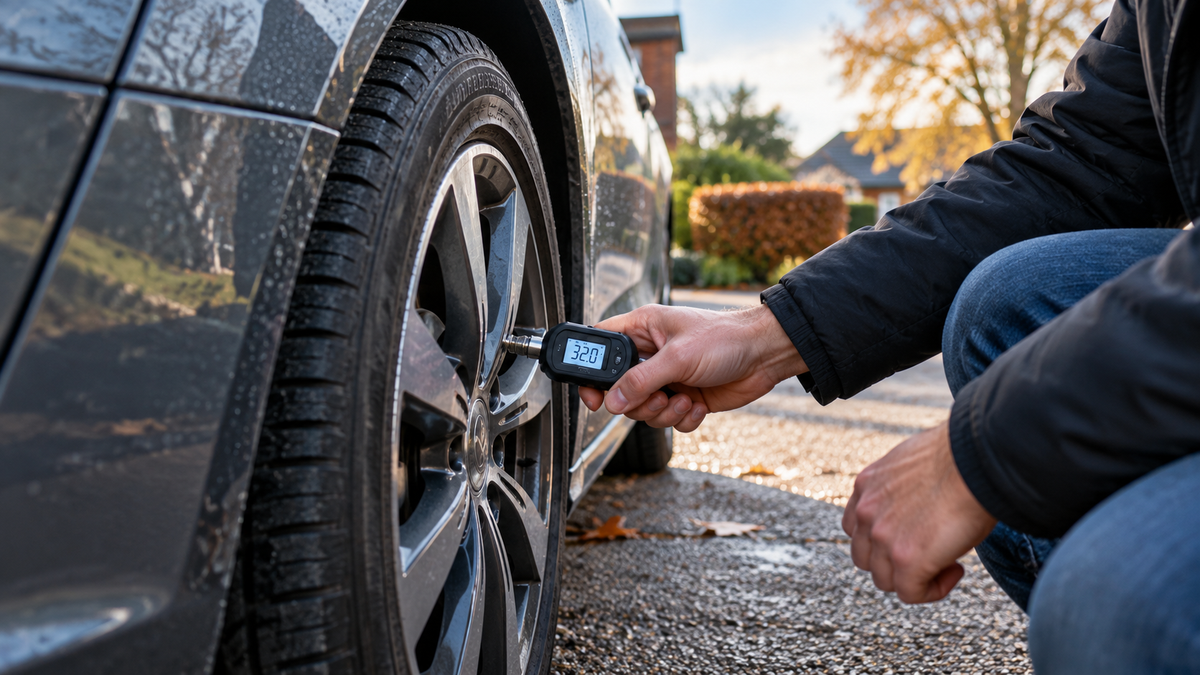
Place the probe of the tread depth gauge into the groove and press the body of the gauge flat against the tread surface.
Step 5: Take several measurements
Do not measure only once. Check several positions around the circumference and across the main tread area because tyres can wear unevenly.
Step 6: Repeat on all four tyres
One healthy tyre does not tell you anything about the condition of the other three.
The Voltaxa Tyre Tread Depth Gauge is designed for quick home checks and is available in both digital and manual versions.

Can you use a 20p coin to check tyre tread?
Yes, the 20p test is a useful quick check and has been promoted by National Highways.
Insert a 20p coin into the main tread grooves. If the raised outer rim of the coin disappears into the groove, the tread is likely to be above the legal minimum. If you can clearly see the outer band, the tread may be too low and should be measured properly.
However, the 20p test has an obvious limitation: it does not give you a precise millimetre measurement.
If a tyre is anywhere near the legal limit, use a proper tread gauge or have the tyre checked professionally rather than relying on the coin test alone.
How often should you check tyre tread depth?
There is no reason to wait for your MOT.
Tyre tread should be part of your regular vehicle checks, particularly:
- before a long journey;
- before motorway travel;
- before autumn and winter;
- if you notice uneven tyre wear;
- after alignment or suspension problems;
- if the vehicle has been driven a high mileage since the last check; or
- whenever a tyre simply looks more worn than the others.
A quick tread check at the same time as your pressure check is an easy routine to build.
For pressure guidance, see our guide: How Often Should You Check Tyre Pressure?
What happens if your tyre tread is below 1.6mm?
A tyre below the legal tread requirement should not be used on the road.
National Highways states that drivers found with illegal tyres can face a fine of up to £2,500 and three penalty points per tyre.
That means several illegal tyres can become a very expensive problem, quite apart from the safety risk.
An illegal tyre can also cause an MOT failure.
Is a tyre safe just because it has 1.6mm of tread?
Not necessarily.
1.6mm is the legal minimum, not a guarantee that every other aspect of the tyre is in good condition.
You should also inspect the tyre for:
- cuts;
- bulges;
- cracking;
- objects embedded in the tread;
- exposed cords;
- uneven wear; and
- damage to the sidewall.
GOV.UK guidance specifically reminds drivers that tyres must have sufficient tread and be free from cuts and other defects.
If you are uncertain about the condition of a tyre, have it inspected by a qualified tyre professional.
Why do tyres wear unevenly?
Tyre wear is not always perfectly even across the tread.
Common causes of uneven wear include:
Incorrect tyre pressure
Running tyres at the wrong pressure can change how the tread contacts the road.
If you are not sure how frequently to check pressure, read our tyre pressure checking guide.
Wheel alignment
Poor wheel alignment can cause one edge of the tyre to wear faster than the rest.
Suspension problems
Worn or damaged suspension components can contribute to unusual wear patterns.
Driving style
Heavy acceleration, braking and aggressive cornering can accelerate tyre wear.
This is why checking tread in several places is important. A tyre may appear healthy at one point while another section is considerably more worn.
Do tyre tread wear indicators replace a tread gauge?
Many tyres have tread wear indicators moulded into the main grooves.
These are small raised bars that become more noticeable as the tread wears down. When the tread surface becomes level with the indicator, the tyre is around its wear limit.
They are useful as a visual warning, but a tread gauge is still the better option when you want to know the actual remaining depth.
What about the spare tyre?
If your vehicle carries a full-size spare wheel, include it in your checks.
A spare can sit unused for months or years, but it can still age, lose pressure or develop problems.
Check:
- tread depth;
- pressure;
- sidewall condition;
- cracking; and
- general tyre age and condition.
A spare wheel is only useful if it is roadworthy when you actually need it.
How tyre tread and tyre pressure work together
Tread depth and tyre pressure are separate checks, but both affect how a tyre performs.
A tyre can have plenty of tread and still be running at the wrong pressure. Equally, a perfectly inflated tyre can still be illegal because the tread is worn out.
That is why a basic tyre-maintenance routine should cover both.
For drivers who want the key tools together, the Voltaxa Tyre Safety Kit combines equipment for checking tyre condition and pressure. You can also browse the wider Car Maintenance collection.
A simple monthly tyre check
You can inspect all four tyres in a few minutes:
- Check the tyre pressure while the tyres are cold.
- Measure the tread depth in several places.
- Look across the full tread for uneven wear.
- Inspect both visible sidewalls for cuts, cracking or bulges.
- Look for nails, screws or other objects in the tread.
- Check the spare tyre if your vehicle has one.
If a tyre is low on pressure, our step-by-step guide to inflating a tyre at home explains how to bring it back to the vehicle manufacturer's recommended pressure.
And if cold weather has caused your pressure reading to fall, see Why Does Tyre Pressure Drop in Cold Weather?.
Frequently asked questions about UK tyre tread depth
What is the minimum legal tyre tread depth for cars in the UK?
For cars, light vans and light trailers, the minimum is 1.6mm across the central three-quarters of the tread width and around the entire circumference of the tyre.
Will 1.5mm tyre tread fail an MOT?
Yes. For a normal car tyre subject to the 1.6mm requirement, 1.5mm is below the legal minimum and would fail the tread-depth requirement.
Is 2mm of tyre tread legal in the UK?
Yes, 2mm is above the 1.6mm legal minimum for cars and light vans, provided the required depth is present across the central three-quarters and around the entire circumference and the tyre has no other defects.
How accurate is the 20p tyre test?
It is useful as a quick visual check, but it does not give an exact millimetre reading. A tread depth gauge is better when you want an accurate measurement or the tyre is close to the legal limit.
Do I need to check tread in more than one place?
Yes. Tyres can wear unevenly, so check several points around the circumference and across the main tread area.
Can I be fined for worn tyres?
Yes. National Highways states that illegal tyres can result in a fine of up to £2,500 and three penalty points per tyre.
Does tyre tread depth affect MOT results?
Yes. Tyre tread depth is checked during the MOT, along with other tyre defects and condition issues.
Final thoughts
The UK tyre tread law is straightforward: 1.6mm across the central three-quarters of the tread and around the full circumference for cars and light vans.
The mistake is assuming that a quick glance is enough.
Use a tread depth gauge, measure more than one point, inspect all four tyres and look for damage at the same time. If a tyre is close to the limit or wearing unevenly, deal with it before it becomes an MOT failure, a roadside problem or an illegal tyre.
A five-minute check on the driveway can tell you a lot about the part of your car that actually keeps you in contact with the road.


Leave a comment
This site is protected by hCaptcha and the hCaptcha Privacy Policy and Terms of Service apply.